


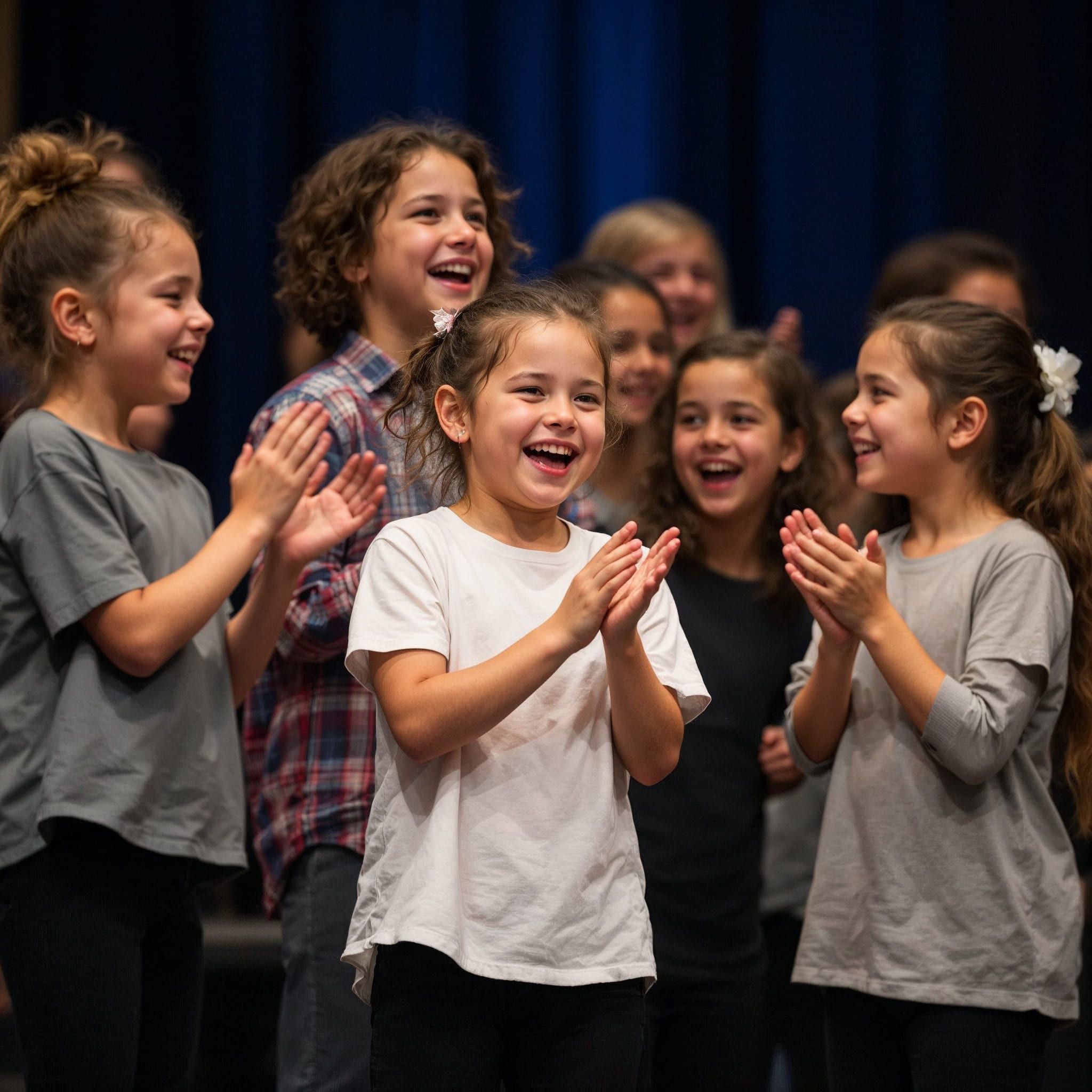
You have thirty students in your cast.
The scene you need to rehearse has five people in it.
So the other twenty-five sit down.
For a while, they watch.
Then they start talking.
Someone needs the bathroom.
Someone else cannot find their script.
And ten minutes later, you are trying to direct five actors while monitoring three conversations and answering the same question again:
“What are we supposed to be doing?”
It feels like the problem is:
How do I keep the other 25 students busy?
I think that is the wrong question.
You do not need twenty-five things to keep them occupied.
You need production work that can keep moving without you.
Because a large cast should not mean thirty students waiting for their turn with the director.
1. Thirty students do not need to be doing the same thing
There are rehearsals when you absolutely need everyone together.
A full company number.
A complicated transition.
A run-through.
A sequence where several parts of the show finally need to connect.
But that does not mean every rehearsal needs to work that way.
If you are blocking a five-person scene, there may be very little value in asking the other twenty-five students to watch for twenty minutes.
Other parts of the show can move forward at the same time.
So instead of asking:
“What can I give the students I don’t need?”
try asking:
“What part of this production can they move forward without me?”
That small change leads to a very different rehearsal room.
2. “Go practise the song” is not independent work
Imagine splitting your cast into groups.
You tell one group:
“Go practise the song.”
Two minutes later:
“Where do we start?”
“Are we using the track?”
“How many times?”
“What do we do when we’ve finished?”
“Can you come over for a second?”
You do not have two groups working.
You have two groups waiting for the director.
Independent rehearsal needs more than an activity.
It needs a finish line.
Instead of:
Practise the chorus.
try:
Get through the chorus three times in a row without looking at the lyrics. Then write down the two entrances that still cause problems.
Now the group knows what it is doing.
It knows what success looks like.
It knows when the task is finished.
And it has something to show you when you return.
That is a much more useful kind of independence.
3. The five-question test
Before I leave a group working without me, I would want to be able to answer five questions.
1. What are they trying to achieve?
Not simply what activity are they doing.
What should be better when they finish?
2. What do they need?
Scripts.
Backing tracks.
Blocking notes.
A choreography reference.
Props.
A speaker.
Whatever allows the group to work without coming back to you every two minutes.
3. Who keeps the work moving?
This does not always have to be your strongest performer.
Sometimes you simply need someone responsible enough to understand the task and keep the group on it.
4. How will they know they are finished?
Three clean runs.
A transition that works.
A completed list.
A section memorised.
Two problems identified.
Give the task an ending.
5. What will they show you when you return?
A run.
A recording.
A list of problem spots.
Updated blocking.
A prop checklist.
If you cannot answer those five questions, the task may not be ready to run independently yet.
4. Build departments, not busywork
This is where large-cast rehearsal becomes much more interesting.
The students who are not working directly with you do not all need to be rehearsing another acting scene.
A musical has many departments.
With thirty students, for example, you could have something like this:
Group 1 · Scene work with you
Five students work on the section that needs direct coaching.
The outcome might be:
Get the five-person entrance running from beginning to end without stopping.
Group 2 · Music
They work on material that has already been taught.
For example:
Run the chorus three times and identify exactly where the group still loses the harmony or entrance.
The important word here is already.
This is not necessarily the group that teaches itself brand-new music.
It is the group that consolidates music it already knows how to work on.
Group 3 · Movement
They clean a section that has already been staged.
For example:
Get the transition from section A to section B running twice without anyone stopping or asking where to go.
Again, I would not normally send a group away to invent or learn an entirely new choreography without the support they need.
But they may be perfectly capable of cleaning something they already know.
Group 4 · Text and cues
Pairs or small groups work through:
lines;
cue pickups;
entrances;
relationships;
problem sections.
One possible task:
Run the scene without looking at the script and mark only the lines that still need prompting.
Now you know exactly where the problem is when you return.
Group 5 · Stage management
A well-organised student or small team can start maintaining the working record of the show:
- entrances and exits;
- blocking changes;
- important positions;
- props;
- unresolved production questions.
This is not fake work invented to keep someone quiet.
It is real production work.
And as the rehearsal process develops, those students can take on more responsibility.
Group 6 · Production or focused observation
Depending on where you are in the process, students might:
- check props;
- prepare a scene-change sequence;
- organise backstage information;
- observe a rehearsal with one specific question;
- record problems that need another session.
Now you no longer have five students rehearsing and twenty-five students being “kept busy.”
You have six parts of the production moving forward at the same time.
5. If every group needs you, you have built five queues
This may be the most useful test in the whole system.
You create five groups.
Every two minutes, one of them needs you.
Then another.
Then another.
You are no longer directing.
You are customer service.
Parallel rehearsal only works when some tasks can genuinely continue without constant intervention.
That means not every piece of work belongs in an independent group.
Some things still need you.
Brand-new music.
A new choreography.
A scene nobody understands yet.
A difficult acting problem.
A complicated staging decision.
Those may need direct teaching first.
Independent groups are particularly useful for consolidation.
They already know the method.
They already know the material well enough.
Now they can repeat it, clean it, diagnose it or document it.
A useful rule is:
Do not send students away to discover something they still need you to teach. Send them away to consolidate something they already know how to work on.
That one distinction can prevent a lot of rehearsal chaos.
6. Give students responsibility — not substitute teachers
For parallel rehearsal to work, responsibility has to spread beyond the director.
But I would be careful about automatically turning the strongest student into a permanent assistant teacher.
Instead, give students specific responsibilities.
You might have a:
Text captain
Keeps a line or cue exercise moving.
Music captain
Keeps the group working on the agreed section.
Movement captain
Helps the group maintain choreography or blocking that has already been taught.
Student stage manager
Records blocking and production changes.
Props lead
Tracks what an upcoming section needs and where it needs to be.
Some of these roles can rotate.
The key is that someone in each group can answer:
“What are we trying to achieve?”
without walking across the room to ask you.
There is another benefit here.
Students begin to understand that a musical is not simply a collection of leading roles.
It is a company.
There are many ways to contribute to making the show work.
7. Watching can be rehearsal too
Sometimes you cannot split the room any further.
Or you actually want students to watch a scene.
That does not automatically mean passive waiting.
Give them one observation job.
For example:
Watch only the entrances.
Is there one moment when somebody seems unsure about exactly when to enter?
Or:
Watch the audience focus.
Where are you looking at each moment?
Or:
Find one place where the energy noticeably drops.
Then collect one or two observations.
Not twenty.
And I would avoid:
“Tell them everything that was wrong.”
That is a very quick way to create twenty new directors.
Focused observation is different.
It trains students to notice one theatrical element at a time.
And learning to identify something in another performance often makes it easier to recognise the same issue in your own work.
8. Parallel work should shrink as the show grows
This system is not right for every stage of rehearsal.
Parallel work is particularly useful while you are:
learning;
building;
cleaning;
memorising;
preparing production elements;
solving specific problems.
But eventually everything has to come together.
A musical cannot open as six beautifully organised rehearsal stations.
As the production develops, the units of work should grow.
Early on, you might work:
5 + 5 + 5 + 5 + 5 + 5
Later:
10 + 10 + 10
Eventually:
30 together
because now you need to test flow, stamina, transitions and continuity.
The rehearsal structure changes because the question has changed.
At the beginning:
Can we build each part?
Later:
Can all the parts survive when we put them together?
What could this look like in a 50-minute rehearsal?
Here is one possible version.
Minutes 0–5 · Everyone together
Give the day’s objective.
Explain each group’s task.
Make sure materials are ready.
Identify who is responsible for each group.
Do not spend ten minutes explaining a complicated rotation system.
If the system itself takes half the rehearsal to understand, it is not helping.
Minutes 5–25 · Parallel work
You work directly with the group that needs you most.
Other groups rehearse, consolidate, observe or complete production tasks.
Minutes 25–35 · Switch or second block
Rotate if needed.
Or move your direct attention to another group that cannot progress independently.
Minutes 35–45 · Integrate
Bring some of the work back together.
Music + movement.
Scene + props.
Entrance + transition.
This is where you find out whether the separate pieces actually connect.
Minutes 45–50 · Show the result
Each group should be able to answer three questions:
What did we improve?
What still breaks down?
What should happen next?
Not every group needs to make a speech.
Sometimes the answer is simply a thirty-second run of what they worked on.
If you also want a structure for making the whole rehearsal more useful, start here:
How to Run a School Musical Rehearsal in 50 Minutes
The goal is not to keep everyone busy
A thirty-student rehearsal will never run like a perfectly programmed machine.
There will be noise.
There will be interruptions.
Some groups will make more progress than others.
That is normal.
But there is a huge difference between:
twenty-five students waiting for their turn
and
twenty-five students moving other parts of the production forward.
So before rehearsal, I would not ask:
“What can the students I don’t need do?”
I would ask:
“What part of this show can they move forward without me?”
That is where a large-cast rehearsal starts to become a company at work.
Luis
Kaikana Musicals
For a show designed for a large, flexible cast, explore The Final Show.