


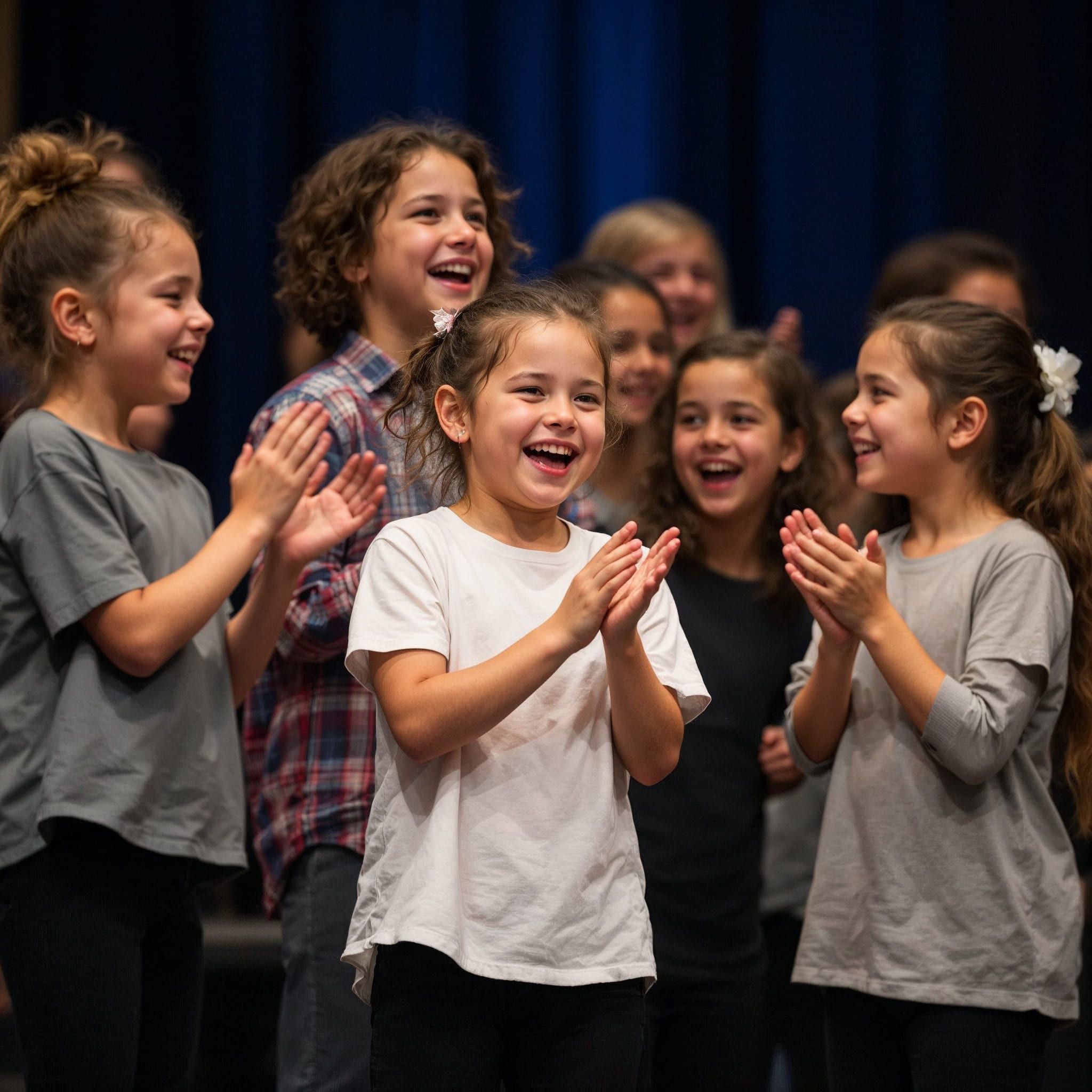
Your students can finally sing the song. But the moment you add choreography, the entrances fall apart, the lead gets hidden behind the ensemble and half the cast starts watching the person next to them.
The usual response is to find an easier dance routine.
I’d start with a different question.
What changes in the story during this number—and how can the audience see it happen?
In Directing in Musical Theatre, Joe Deer distinguishes three levels of stage action: everyday blocking, organised musical staging and formal choreography. A school production doesn’t always need the third.
Sometimes the most effective number is built from clear relationships, a few precise movements and well-chosen musical cues.
1. Decide whether you actually need a dance
Suppose a character is trying to persuade a group to open a mysterious door.
You could teach everyone the same eight-count combination.
Or you could let the character approach, have one group step away, and allow the others to change their minds as the song develops.
The second version needs fewer steps, but it shows a story.
Choose the right level of movement:
Blocking: characters walk, stand, turn, sit or approach because the scene gives them a reason.
Musical staging: those actions become more organised and precisely timed with the music, without becoming a dance routine.
Choreography: performers execute a more formal, repeated or technically demanding movement sequence.
These categories can coexist in one number. The goal isn’t to avoid dancing; it’s to stop treating dancing as the default solution to every song.
2. Draw two maps before moving the cast
Listen to the full rehearsal track and mark the musical structure: introduction, verse, chorus, instrumental transitions, accents and final chord.
Next, map the dramatic action.
Avoid vague descriptions such as “everyone feels nervous.” Write playable actions:
persuade → resist → challenge → join.
For example:
- Group A blocks the lead character’s plan.
- The lead persuades Group B.
- Group B supports the lead.
- Group A finally agrees to help.
Deer calls attention to the way characters’ actions cause responses from others. The physical staging should make those exchanges legible.
Now put the two maps together.
Where does a new musical phrase strengthen an argument? Where does a silence make a refusal more powerful? Where does the chorus mark the turning point?
Don’t schedule a formation change every eight counts simply because eight counts have passed. A move is valuable when it coincides with something that matters.
3. Make a practical staging score
This six-column staging score is our classroom adaptation of Deer’s action analysis and blocking notes.
| Musical moment | Story change | Playable action | Audience focus | Physical movement | Audible cue |
|---|---|---|---|---|---|
| Intro | Uncertainty | A blocks the plan | Lead and doorway | Two separate groups | First chord |
| Verse | An appeal | Lead persuades B | Lead, then B | Lead approaches | First key lyric |
| Reply | Resistance | A challenges | Group A | A stays still; B advances | Change in texture |
| Chorus | Decision | B draws A in | Lead, then ensemble | A pathway opens | Chorus entry |
| Ending | Agreement | Ensemble commits | Final group picture | Hold a shared position | Last chord |
This gives you something specific to rehearse: an event, an action, an audience focus, a path and a cue.
It also helps diagnose problems. A student might know where to stand but not understand why they’re moving, or understand the action but not recognise the musical signal.
4. A worked 16-bar example
Imagine an original number in 4/4, with twelve performers divided into two groups, A and B, and one principal performer, P (who may already belong to a group).
The dramatic action: P wants the group to go through a mysterious door.
From the audience:
UPSTAGE

   A A A             B B B

    A A A           B B B

              P

           [DOOR]

           AUDIENCE
Bars 1–4: Resist. A holds a compact shape to the left. B stays further away. P faces the door. Focus falls first on P, then on the visual weight of Group A.
Bars 5–8: Persuade. On the opening lyric of the next phrase, P approaches B. Two members of B turn first, the others follow. This creates a visible reaction rather than a random formation change.
Bars 9–12: Challenge. A remains still. B forms a clear pathway. P walks into the open space. The contrast between movement and stillness makes resistance visible.
Bars 13–16: Accept. At the chorus or the relevant musical accent, A joins the new formation. The ensemble faces the door, leaving P visible. The final picture holds through the last chord.
These four-bar divisions are an illustration, not a universal rule. The actual lyrics and phrasing of your score should decide the timing.
The cast has made a dramatic journey with only a few simple moves.
5. Direct the audience’s eye
Deer identifies several qualities of effective stage composition:
Emphasis: where the audience looks first and second. A soloist may disappear if everyone moves at once.
Visual weight: a cluster of eight performers can create a strong counterweight to one person standing alone.
Depth: positions upstage and downstage can make a picture more readable than a flat line.
Levels: seated and standing performers can add contrast, provided every position is safe and accessible.
Physical relationship: approaching, separating and turning away communicate connection, resistance and changing attitudes.
Watch the number without music from the audience, then check it from the sides.
Can you see the important faces? Is the lead clear? Does the distance between groups communicate something?
This silent viewing is a staging test, not just a dance-cleaning exercise.
6. Cue movement to specific musical or dramatic events
Joseph Church’s Music Direction for the Stage explains cueing as the point where music meets dialogue, physical action, lighting or another event.
For beginners, a clear cue is much more helpful than “remember to move around that point.”
Write:
- “Turn on the word ‘now’.”
- “Take two steps on the percussion entrance.”
- “Stop at the end of the instrumental phrase.”
- “Hold the final image until the accompaniment ends.”
Also rehearse the moments around the number. A great choreographed middle section won’t help if the cast doesn’t know when the first sung line begins or what happens after the final chord.
If moving makes the students lose the music, isolate the difficult passage and restore it before combining tasks. Our rehearsal tracks guide explains that progression.
7. Three Rooyackers exercises for specific staging problems
Paul Rooyackers’ 101 More Drama Games for Children offers exercises that can be adapted to ensemble staging.
Who Is the Mirror? (book p. 45): two students stand side by side and try mirroring using peripheral vision, then switch roles. Use it when performers keep turning their heads to check whether everyone else has moved.
Equality (book p. 46): the group follows a leader’s simple motion, then attempts the same kind of gradual change without an obvious leader. Use it to develop awareness within a group formation.
Rewind (book p. 47): students perform a short sequence of everyday actions, then slowly reproduce it in reverse while a partner watches for omissions. Use it to help students notice the actual sequence of movements, not just the start and end shapes.
These are exercises in attention and movement recall, not replacements for the musical’s rehearsal. Choose the one that addresses your current problem.
8. The 15-minute staging diagnostic
- Silent story test: arrange the beginning, turning point and ending. Can an observer tell what has changed?
- Traffic test: walk the routes. Does anyone block the performer the audience needs to see?
- Cue test: rehearse only transitions and the events that trigger them.
- Singing test: add voices. Where does the music start to unravel?
- Side-seat test: check that the composition remains clear away from the centre aisle.
Don’t respond to every mistake with another full run-through.
Ask whether students missed a cue, misunderstood an action, couldn’t complete a route in time or lost the song when tasks were combined.
Then rehearse the cause.
9. Five mistakes worth avoiding
Dancing through every verse. Stillness can help make a lyric or decision important.
Equating bigger movement with better storytelling. Sometimes one step carries the entire dramatic change.
Changing formations only at eight-count boundaries. Listen for where the music and story actually turn.
Hiding the important performer. Check the picture from the audience before repeating it.
Making complexity more important than singing or safety. Your staging must suit this cast and this space.
10. Use choreography resources as references, not a script for every body
Suggested choreography videos can help you see where movement, formations and musical energy meet.
Kaikana Musicals’ The Final Show, for example, includes ten suggested choreography reference videos, alongside the script, musical tracks and production materials.
But you don’t need a cast of trained dancers to make a number work.
You need to know who is trying to change whom, where the audience should look, and which musical signal triggers each action.
That’s a directorial skill, not a dance competition.
Luis
Kaikana Musicals